

CISPR and ANSC C63® Overview on Site Validation Measurements from 18 GHz to 40 GHz
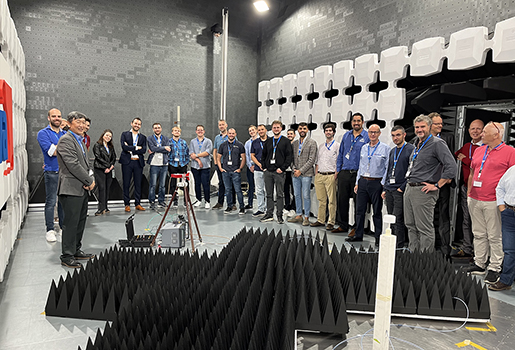
Learn About the Latest Developments in EMC Test Site Evaluation Using Advanced Antenna Measurement Techniques at Three Global Events
Cedar Park, Texas, February 19, 2026 – ETS‑Lindgren announced the company’s Chief Engineer, Zhong Chen, is an invited speaker at three upcoming global events, starting with the Institute of Electrical and Electronics Engineers (IEEE) Electromagnetic Compatibility (EMC) Society Seattle Chapter with the Antennas and Propagation, Electron Devices, Microwave Theory and Technologies (AP/ED/MTT) Joint Chapter Workshop on Thursday, March 12, at The Boeing Company in Seattle, Washington.
Next, Mr. Chen will present at the EMV 2026 Conference on Tuesday, March 24, at Cologne Koelnmesse in Cologne, Germany, followed by his presentation at the IEEE EMC Society Poland Chapter Workshop on Tuesday, March 31 at Łukasiewicz – Poznań Institute of Technology in Poznań, Poland.
Mr. Chen’s presentation, “CISPR and ANSC C63 Overview on Site Validation Measurements from 18 GHz to 40 GHz,” provides information on the latest developments in EMC test site evaluation using advanced antenna measurement techniques. Attendees of the presentation will also witness a live demonstration of the measurement technique that complements Mr. Chen’s lecture material. Mr. Chen is Vice-Chair of ANSC C63, the standards organization that is currently drafting new standards to address EMC measurements from 18 GHz to 40 GHz.
“My presentation introduces a novel approach for EMC chamber validation beyond 18 GHz, currently under consideration in ANSC C63 and CISPR standards,” said Mr. Chen. “By integrating the cylindrical mode filtered site voltage standing wave ratio (CMF SWR) with compressed sensing, we address inherent challenges in traditional SVSWR methods, such as inconsistency and slow data acquisition,” he explained. “CMF SVSWR utilizes circular path measurements and mode domain post-processing to discern antenna and chamber reflections, crucial for comprehensive VSWR analysis. Compressed sensing, a data-driven machine learning technique, exploits signal sparsity to reconstruct data from fewer randomly sampled measurement points, thereby reducing test times and eliminating the need for precise turntable positioning.”
In the CMF SVSWR live demonstration following the presentation, Mr. Chen will show how CMF SVSWR is measured by placing the transmit antenna (typically a low gain omni-directional antenna) at the edge of the turntable and performing a single cut vector pattern measurement. The vector S21 as a function of turntable angle at each frequency is transformed to the spectrum domain, where a filter can be applied to mathematically remove the chamber effects. The SVSWR is derived by comparing the original pattern in the chamber to the “clean” filtered pattern. The demonstration shows how CMF SVSWR provides a more comprehensive evaluation of the EMC chamber quiet zone and can be readily measured without any special positioning fixtures. Attendees will view an entire measurement process including the post-processing, which can be performed in real time. This new measurement technique is under consideration for the draft standard ANSI C63.25.3 under development by the ANSC C63 committee for EMC test sites from 18 GHz to 40 GHz.
Mr. Chen has more than 25 years of experience in RF testing, anechoic chamber design, and EMC antenna and field probe design and measurement. In addition to serving as the ANSC C63 Committee Vice-Chair, he is the immediate past Chair of Subcommittee 1, responsible for the antenna calibration (ANSI C63.5) and chamber/test site validation standards (ANSI C63.4 and the ANSI C63.25 series). Mr. Chen also serves as Chair for both the IEEE Standard 1309 Committee, charged with developing calibration standards for field probes, and the IEEE Standard P1128 Working Group, tasked with absorber evaluation.
Mr. Chen formerly served as a member of the IEEE EMC Society Board of Governors and the Antenna Measurement Techniques Association (AMTA) Board of Directors. He is a past Distinguished Lecturer for the IEEE EMC Society and is recognized as an AMTA Fellow.
His research interests include measurement uncertainty, time domain measurements for site validation and antenna calibration, and development of novel RF absorber materials. Mr. Chen has authored and co-authored several papers that received Best Paper recognition at global conferences. He earned his M.S.E.E. degree in Electromagnetics from the Ohio State University at Columbus.
For more information on these events and how to attend, visit IEEE EMC Society Seattle Chapter, EMV 2026, and IEEE EMC Society Poland Chapter. Please note attendance is strictly limited at the Seattle and Poznań Workshops; seating will be confirmed on a first-come, first-served basis with advance registration only. Click here for more information on ANSC C63.
For more information on ETS‑Lindgren’s EMC Solutions, click here. And, to visit with our sales professionals, email us or call us at +1 (512) 531-6400 USA.
About ETS‑Lindgren
ETS‑Lindgren is an international manufacturer of components and systems that measure, shield, and control electromagnetic energy. The company’s products are used for electromagnetic compatibility (EMC), microwave, wireless, and magnetic resonance imaging (MRI) testing, electromagnetic field (EMF) measurement, and radio frequency (RF) personal safety monitoring.
Headquartered in Cedar Park, Texas, ETS‑Lindgren has manufacturing facilities in North America, Europe, and Asia. The company is a wholly owned subsidiary of ESCO Technologies, a leading supplier of engineered products for growing industrial and commercial markets. ESCO is a New York Stock Exchange listed company (symbol ESE) with headquarters in St. Louis, Missouri. Additional information about ETS‑Lindgren is available at www.ets-lindgren.com. Follow ETS‑Lindgren on Facebook, Instagram, LinkedIn, X, and YouTube. Additional information about ESCO and its subsidiaries is available at www.escotechnologies.com.
CONTACT:
Janet O’Neil
Marketing and Communications
Office: +1 512-531-2676