

Boeing Dual Robotic Antenna Measurement System
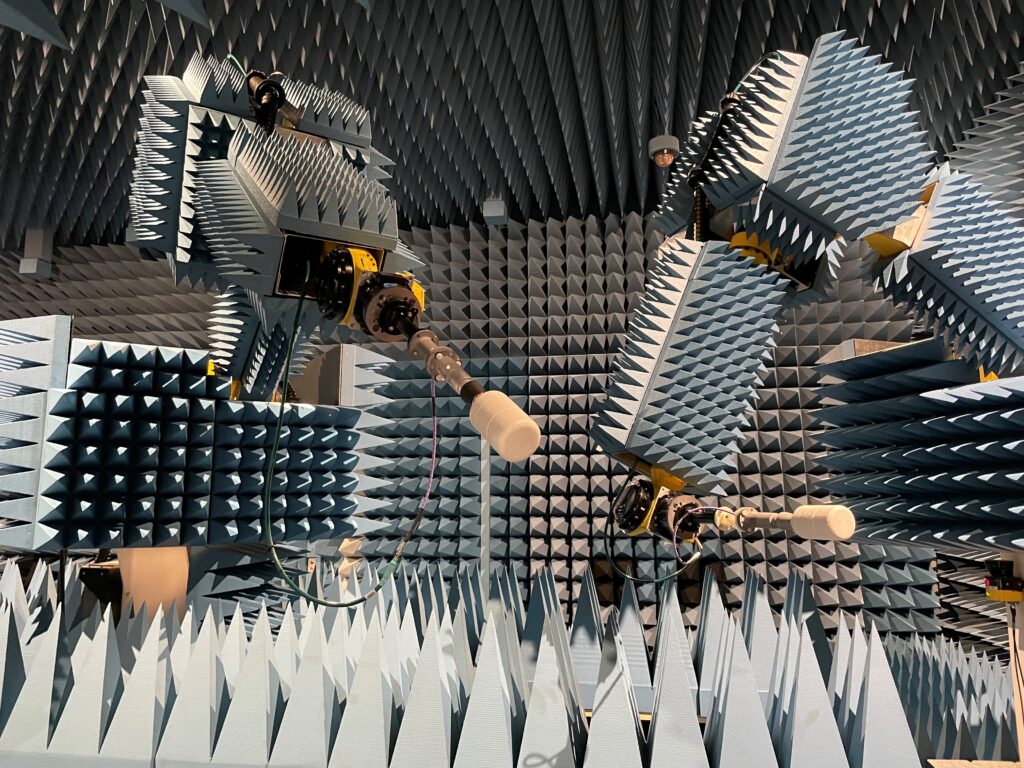
For many years, Boeing’s goal was to make antenna measurements dramatically faster, more efficient, and higher quality. Boeing achieved this goal with the addition of the new Dual Robotic Antenna Measurement System (DRAMS) – a multipurpose antenna range for a wide variety of measurements. While antenna measurements have traditionally been made with elaborate customized positioners, with the advent of highly accurate 6-axis robots, commercial off-the-shelf (COTS) robots can accomplish many of these customized antenna positioner movements. Robots significantly increase efficiency and safety while reducing test time. ETS‑Lindgren provided a dual 6-axis robotic system to perform near-field pattern, gain, and polarization measurements. Scan geometry capabilities include spherical, cylindrical, geometry planar near field, far field, and gain extrapolation. Additional capabilities include the ability to
customize the data acquisition to perform coordinated motion in other laboratory and calibration experiments not yet envisioned in the system. In addition to providing the RF shielded enclosure to house the robots, large equipment access doors, and anechoic material to line the enclosure, ETS‑Lindgren’s
in-house and certified building information modeling (BIM) capabilities complemented Boeing’s model-based system engineering. The modeling enabled the evaluation of individual components within the system as well as established the form and magnitude of the interactions between the various subsystems. Before final design and construction, the models provided an indication of overall system performance through a sensitivity analysis that would otherwise have been too costly or time prohibitive to perform experimentally. The models gave Boeing the confidence to move forward with the project and
partner with ETS‑Lindgren to achieve their goal.
RF Shielded Anechoic Chamber
The DRAMS system is housed in an ETS‑Lindgren Series 81 RF shielded enclosure, a proven design with over 50,000 worldwide installations. The enclosure features shielded modular panel sections assembled with a clamping system, utilizing 28-gauge galvanized steel sheets laminated to a high-density particle and/or plywood board core. Panels are joined together using precision-machined clamping sections to ensure uniform pressure contact and corrosion resistance. Secure fasteners spaced 10 cm (4 in) apart and trihedral end cap sections further enhance the enclosure’s structural integrity.
- Overall chamber dimensions of 12.8 m L x 8.2 m W x 5.7 m H (42 ft L x 27 ft W x 19 ft H) including structure.
- Nominal 1.2 m x 1.2 m (4 ft x 4 ft) absorber fence located in front of the robot system controllers.
- Seismic design, bracing, and engineering stamp required for the installation located in a high seismic zone area.
- Series 81 RF shielding provides excellent RFI and EMI shielding effectiveness and is the most commonly specified shielding for NSA 65-6/NSA 94-106 testing requirements. Series 81 delivers high-performance attenuation over a broad frequency range.
RF Shielded Doors
- Single leaf semi-automatic latch (electric) 1.2 m W x 2 m H (4 ft W x 7 ft H) RF shielded door with limit switch and HASP lock accommodations.
- Dual leaf semi-automatic latch (electric) 3 m W x 2 m H (10 ft W x 8 ft H) RF shielded double leaf door with limit switch and HASP lock accommodations (two sets of these doors were provided for the front and back walls of the chamber).
- Two-piece aluminum ramp supporting 226 kg (500 lb) wheeled loads for the double leaf door.
RF/Microwave Absorber
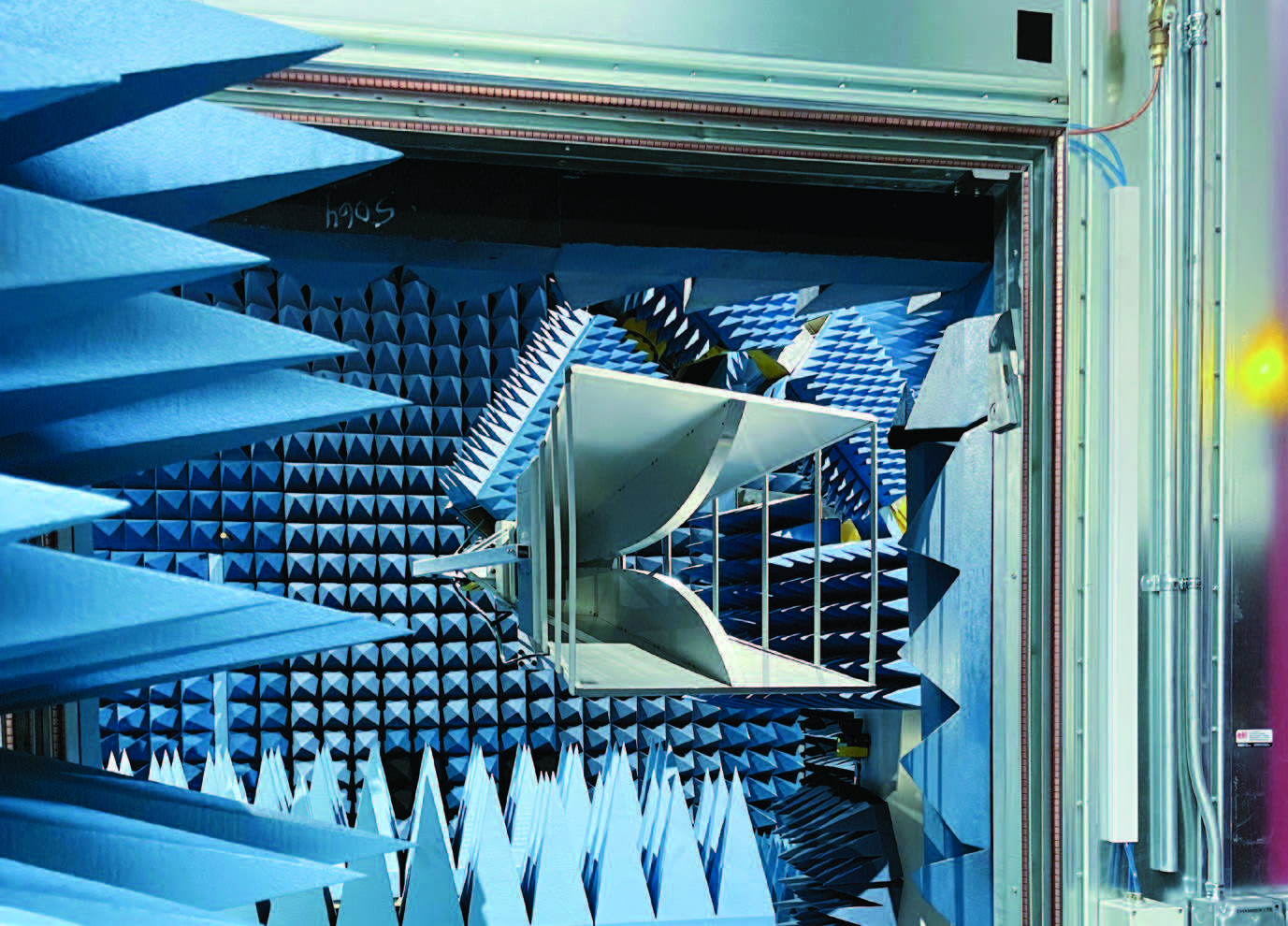
The RF shielded enclosure in the DRAMS is lined with ETS‑Lindgren absorber materials to minimize reflections in the test environment. ETS‑Lindgren employs a unique two-step impregnation process to enhance the polyurethane absorber material’s performance and fire resistance. Initially, the urethane
foam block is compressed and submerged in a mixture of conductive carbon and neoprene latex, ensuring complete distribution throughout the foam cells. The second step involves incorporating a solution of fire retardant ingredients. This meticulous two-step process results in uniformly impregnated absorbers that deliver consistent RF performance across a wide frequency range.
- ETS‑Lindgren Model EHP‑24PCL, 60 cm (24 in) pyramidal absorber lined all six sides of the chamber.
- Power Handling: 775W per m² (0.5W per in²).
- Fire Retardant Performance meets:
– NRL Report 8093 (Tests 1, 2, and 3)
– MIT Lincoln Laboratory Specification MS-8-21 (1, 2, and 3)
– Raytheon Drawing No. 2693066 (latest revision)
– UL 94-5VA and UL 94-5VB
– UL 94 HBF
– DIN 4102 Class B-2
About ETS‑Lindgren
ETS‑Lindgren is an international manufacturer of components and systems that measure, shield, and control electromagnetic and acoustic energy. The company’s products are used for electromagnetic compatibility (EMC), microwave and wireless testing, electromagnetic field (EMF) measurement, radio frequency (RF) personal safety monitoring, magnetic resonance imaging (MRI), and control of acoustic environments.
Headquartered in Cedar Park, Texas, ETS‑Lindgren has manufacturing facilities in North America, Europe, and Asia. Additional information about ETS‑Lindgren is available at www.ets-lindgren.com. Additional information about ETS‑Lindgren’s parent company ESCO and its subsidiaries is available at www.escotechnologies.com.